Nursing Requirements

Preparing for the nursing program
Before you Apply
Admission to the Nursing program is a separate process from general CCC enrollment. The program is competitive, sequential, and limited to approximately 30 students per year. Applications are reviewed once per year for fall semester entry.
Most students spend two to three semesters completing prerequisite coursework before applying. During that time, many also work as nursing assistants, which provides patient care experience and satisfies the LNA licensure requirement for admission.
If you do not yet have your Arizona Nursing Assistant (LNA) license, start with CCC’s Certified Nursing Assistant program. Earning your LNA is a required step before you can apply to Nursing.
Attend an Information session
All applicants must attend a required Application Information Session before submitting a Nursing program application. These sessions cover the application process, selection criteria, and program expectations in detail.
Prerequisite Coursework
Before applying to the Nursing program, you must complete the following prerequisite courses with a grade of C or higher. Students with a completed Bachelor of Arts or Bachelor of Science degree may use that degree to satisfy ENG 101, ENG 102, and MAT 140 only, provided those courses were not already part of the degree. All other prerequisites are required regardless of prior degree.
- ENG 101 — College Composition I (3 credits)
- ENG 102 — College Composition II (3 credits)
- MAT 140 or higher — College Mathematics (3–5 credits)
- BIO 201 — Human Anatomy & Physiology I (4 credits)
- BIO 202 — Human Anatomy & Physiology II (4 credits)
- CHM 130 — Fundamentals of Chemistry (4 credits)
The following courses are co-requisites and are strongly encouraged to be completed before entering the program:
- BIO 205 — Microbiology (4 credits)
- BIO 218 — Human Pathophysiology (4 credits)
- NTR 135 — Human Nutrition (3 credits)
- PSY 240 — Developmental Psychology (3 credits)
- Arts & Humanities elective (3–4 credits)
All prerequisite and co-requisite courses must be completed with a cumulative GPA of 3.0 or higher on a four-point scale to be eligible for admission.
Admissions requirements
Admission to the Nursing program is competitive and separate from general CCC admission. Meeting the minimum requirements does not guarantee acceptance. Applications are reviewed once per year, with applications due in May for fall semester entry.
To apply, you must have completed all of the following:
- A grade of C or higher in all required prerequisite courses, with a cumulative GPA of 3.0 or higher on prerequisite coursework
- A current, unexpired Arizona Nursing Assistant (LNA) license
- A current, unexpired Arizona DPS Fingerprint Card, Level 1
- Completion of the ATI TEAS exam with a minimum score of 66.1%
- Attendance at a required Application Information Session
- Submission of a completed application
[Download Nursing Program Applications and Application Checklist]
- How are applications reviewed?
Applications are reviewed by Nursing program faculty following the May deadline. Applicants are notified of admission decisions following the review period. Acceptance is conditional on completion of all health documentation and orientation requirements before the program start date. Students who are not accepted may reapply in a subsequent cycle.
Students must earn a grade of B or higher in each core nursing course to progress. A grade below B may result in the student being unable to continue to the next nursing course. Contact the Nursing Department for information about re-admission procedures if a student does not progress.
- What is the ATI TEAS exam?
The ATI TEAS (Test of Essential Academic Skills) is a standardized exam that measures foundational skills in reading, mathematics, science, and English. CCC requires a minimum composite score of 66.1% for Nursing program admission.
The exam is available at CCC and other approved testing locations. Students who do not meet the minimum score on their first attempt may retest, with a required 30-day waiting period between attempts. Only the most recent score is considered during application review.
Contact the Nursing Department for current scheduling and testing site information.
Download: ATI TEAS Exam Information[ATI-TEAS-Information.pdf]
health and Documentation Requirements
All accepted students must provide complete health documentation before beginning the program. These requirements protect both students and the patients they will care for during clinical rotations. It is each student’s responsibility to obtain, maintain, and submit updated documentation throughout the program.
Health records are submitted through CastleBranch, CCC’s health documentation management system. Instructions for accessing CastleBranch are provided during orientation.
Download: Immunization and Health Records Checklist [Nursing-Health-Checklist.pdf]
Download: CastleBranch Setup Instructions [CastleBranch-Instructions.pdf]
- Required Immunizations and Health Records
- Confidential Medical History Form
- Negative TB skin test (Mantoux), current through May 15 of each academic year. If prior skin test was positive, a chest X-ray or other approved testing is required.
- MMR (Measles, Mumps, Rubella): two vaccines or blood titer showing immunity
- Varicella (Chickenpox): two vaccines or blood titer showing immunity
- Hepatitis B: completed vaccine series or signed declination form
- Tdap: within the past ten years
- Flu vaccine: annually by September 1
- COVID-19: evidence of full vaccination
- 10 or 12 panel urine drug screen: within 60 days of first clinical day
Download: Drug Screen Information[Drug-Screen-Instructions.pdf]
- Required Certifications and Clearances
- American Heart Association BLS Provider certification (must remain current throughout the program; renews every two years)
- Current, unexpired Arizona Nursing Assistant (LNA) license
- Current, unexpired Arizona DPS Level 1 Fingerprint Card
- Annual Renewal Requirements
Students continuing in the program must renew the following before the start of each academic year:
- TB skin test, due by May 15
- Flu vaccine, due by September 1
All documents with expiration dates must remain current throughout the program. Expired documentation may result in the student being unable to participate in clinical rotations.
Clinical Training and Simulation
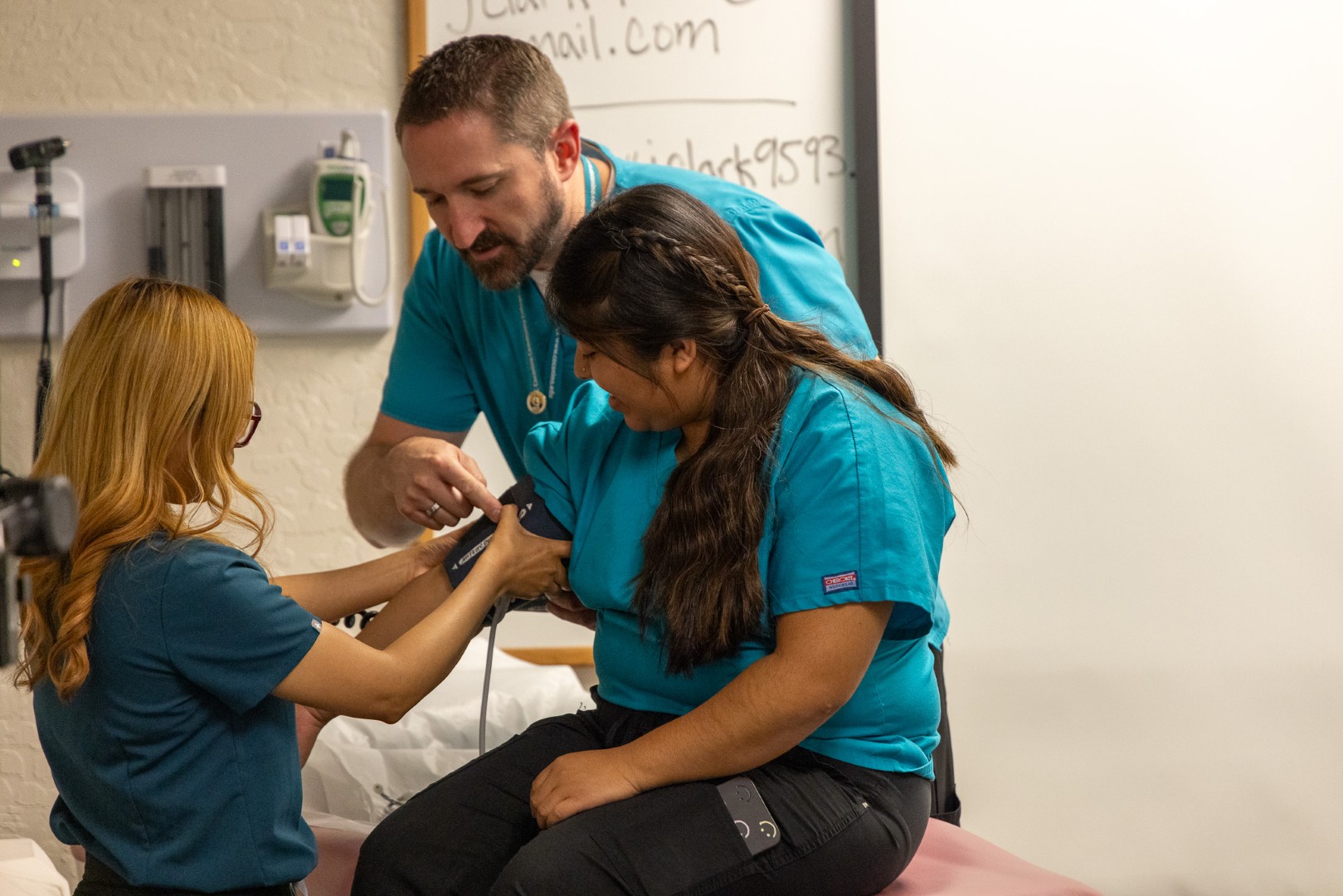
A significant portion of the Nursing program takes place outside the traditional classroom. Students participate in skills lab training, simulation exercises, and clinical rotations at local healthcare facilities throughout the program. Clinical rotations provide hands-on patient care experience under the direct supervision of a clinical nursing instructor.
- What does clinical training look like?
Clinical training takes place in three settings: CCC’s on-campus skills lab, simulation exercises, and supervised rotations at local and regional healthcare facilities. Before providing patient care, students practice foundational skills in the skills lab and through simulation exercises. Students must score 100% on a medication calculation test before administering medications during any clinical rotation.
Clinical rotations are assigned by the Clinical Coordinator and vary by semester. Sites may include facilities in Flagstaff and surrounding communities. Transportation to clinical sites is the student’s responsibility.
- What are the attendance requirements?
Attendance at all clinical experiences is mandatory. If a student must miss a clinical day, they must notify their instructor before the scheduled start time. A makeup day is required for any missed clinical experience. Failure to complete required clinical hours may affect a student’s ability to progress.
- Are there work restrictions during the program?
Students enrolled in the Nursing program may not work for eight or more full hours immediately before any clinical rotation or class. This is a safety requirement to protect both students and the patients in their care.
Program Policies
The Nursing program has clear expectations for how students progress, conduct themselves, and show up for the work. Knowing these policies before you start helps you plan ahead and focus on what matters most: becoming a competent, confident nurse.
- What is the progression policy?
Students must earn a grade of B or higher in each core nursing course to progress to the next course. The nursing core is sequential, with each course building on the previous one. Students who do not meet the progression standard may need to apply for re-admission in a subsequent cycle.
- What are the professional conduct expectations?
Students are expected to maintain professional conduct at all times, including in the classroom, skills lab, simulation center, and clinical settings. This includes compliance with HIPAA regulations, respectful communication with patients, families, and healthcare team members, and adherence to all facility and program policies.
Social media use related to clinical experiences is strictly prohibited. Students may not post, photograph, or share any information that could identify a patient, clinical facility, or clinical situation.
- What technology will I need?
Nursing students must have access to a personal computer every day. A laptop is strongly recommended for proctored testing. On-campus computer labs are available if needed.
The program uses Assessment Technologies Institute (ATI) throughout all four semesters of the nursing core. ATI modules and assessments are assigned each semester. ATI subscription and assessment fees are the student’s responsibility.
- What is the dress code?
Students are required to wear approved nursing scrubs during all clinical experiences and skills labs. Specific requirements, including color and approved footwear, are outlined in the Nursing Student Handbook.
- What if I am transferring from another nursing program?
Students who have completed nursing coursework at another accredited institution must submit a separate transfer application, including official transcripts, course syllabi for all completed nursing courses, and a letter from the Director of Nursing at the previous institution. Acceptance is evaluated by CCC’s Director of Nursing and depends on program compatibility and space availability.
Program Costs
In addition to standard CCC tuition and fees, nursing students should plan for the following program-related expenses. A detailed cost breakdown is available in Appendix F of the Nursing Student Handbook.
- Approved nursing scrubs and footwear
- ATI subscription and assessment fees, billed each semester
- Textbooks and clinical resource materials
- Physical examination fees
- Immunization costs, if not already vaccinated
- Urine drug screen fees
- CastleBranch health documentation subscription
- American Heart Association BLS Provider certification fees
- Arizona DPS Level 1 Fingerprint Card fees
- NCLEX-RN application and examination fees, paid after graduation
Financial aid, Pell Grants, CCC Foundation scholarships, and workforce funding through programs such as WIOA may be available to eligible students. [LINK: Contact the Financial Aid office for current eligibility information.]
NCLEX-RN Examination
Upon completing the Nursing AAS, graduates are eligible to apply to sit for the NCLEX-RN, the national licensure examination required to practice as a registered nurse in Arizona and most other states. Passing the NCLEX-RN is required to obtain an Arizona Registered Nurse license through the Arizona State Board of Nursing.
CCC’s 2025 NCLEX-RN first-time pass rate was 90%, above the Arizona state average of 89.3% and the national average of 86.5%.
Forms and Documents
Download the forms and documents you need for each stage of the Nursing program below. Contact the Nursing Department if you have questions about which documents apply to your situation.
- Applying to the Program
Applying to the Program
Download: Nursing Program Application [Nursing-Program-Application.pdf]
Download: Application Checklist [Nursing-Application-Checklist.pdf]
Download: ATI TEAS Exam Information [ATI-TEAS-Information.pdf]
- Health and Documentation
Download: Immunization and Health Records Checklist [Nursing-Health-Checklist.pdf]
Download: Functional Ability Requirements [Nursing-Functional-Ability.pdf]
Download: CastleBranch Setup Instructions [CastleBranch-Instructions.pdf]
Download: Drug Screen Information [Drug-Screen-Instructions.pdf]
- Program Information
Program Information
Download: Nursing Student Handbook (current semester) [Nursing-Student-Handbook.pdf]
Download: Nursing Program of Study Map [Nursing-Program-Map.pdf]
Download: Prerequisite Checklist [Nursing-Prerequisite-Checklist.pdf]
- Licensure and Certification
Arizona State Board of Nursing: azbn.gov
NCLEX-RN Candidate Bulletin: ncsbn.org
Frequently Asked Questions
- What happens if I do not pass a nursing course?
Students must earn a grade of B or higher in each core nursing course to progress. A grade below B may result in the student being unable to continue to the next nursing course. Contact the Nursing Department for information about re-admission procedures if a student does not progress.
- What if I started a nursing program at another institution?
Transfer into the Nursing program from another institution requires a separate application process, including submission of transcripts from the prior nursing program, syllabi for completed nursing courses, and letters from the previous program. The Director of Nursing evaluates prior coursework for eligibility and placement. Acceptance is dependent on space availability and program compatibility.
- Is admission guaranteed if I meet the minimum requirements?
No. The program is competitive with approximately 30 students accepted per year. Meeting minimum requirements does not guarantee admission.